
From Stress to Strength: From People-Pleasing to Self-Care (A Therapist’s Guide for Women)
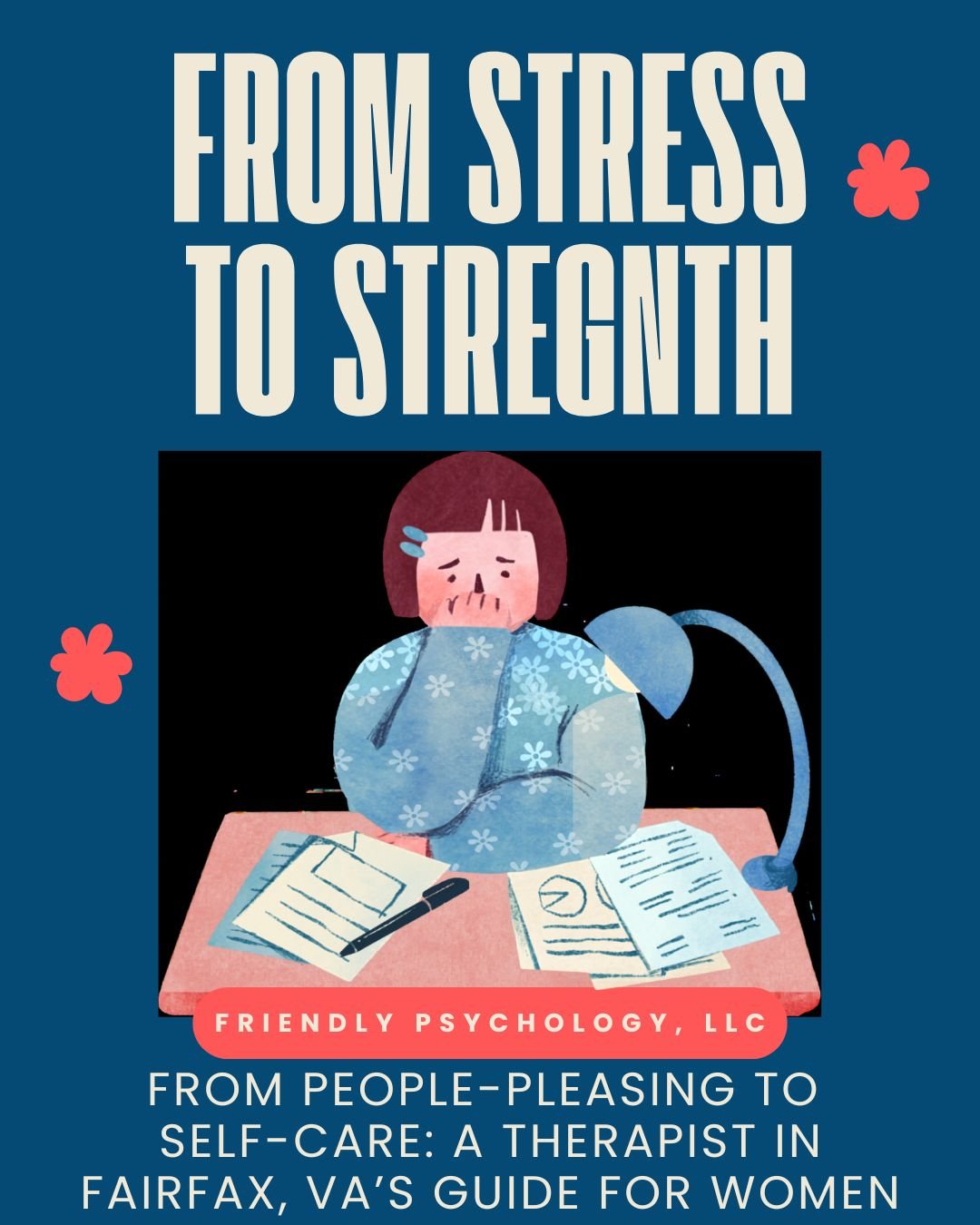
If you’ve read the previous posts in this blog series, you’ll recognize the theme here:
Women are socialized to care for others.
We are not socialized to care for ourselves.
In fact, many of us are taught that prioritizing our needs makes us selfish and bad. This leaves us desperate to please others so that they know (so that we can then know) that we are not selfish and we are not bad.
The trouble is all of this leaves us exhausted, depleted, and overwhelmed. And if we are always caring for others, who is caring for us?
If you still need convincing that we need care too, check out my previous post, “From Stress to Strength: Transformations with a Therapist in Fairfax, VA.” And read on below for some inspiration about how to go from people-pleasing to self-care.
Finally, reach out to a therapist in Fairfax, VA to get support transforming your own life!
Language Matters
One of the things that makes it difficult to change the behaviors we were socialized into is that they become part of our identity. We even name ourselves accordingly: I am a People-Pleaser.
But the thing is, language matters, and the words we use with ourselves have great power. If I am a People-Pleaser, then I have no choice but to people-please because it is literally Who. I. Am.
So, what do we do?
One thing we can do is start to intentionally change the language we use. We can shift from “I’m a People-Pleaser” to “I am someone who cares for others and myself.” Just that small shift, from identity-based to behavior-based language, can give us the psychological space to start to shift towards a healthier life.
Habits are Huge
It’s truly amazing how much of our behavior is governed by our habits. Even once we start to change our language to allow for a more expansive identity, we have to contend with the years upon years of habits that keep us stuck in patterns that no longer serve us.
So, how do we change that?
I can’t stress enough the power of noticing! The first step in changing any pattern is to notice when we are enacting it. You can’t change what you can’t see.
Start simple. Try to notice when you have done something ‘people-pleasy’ and make a note of it. Then, as that gets easier to see, start to notice you are people-pleasing as it’s happening. The final step is to notice the urge to people-please before you do it. Once you can tune into the urge before it is enacted, you suddenly have a choice about whether to follow your urge or not.
You can also use what’s called “implementation intentions.” You decide ahead of time, “if X happens, I will do Y.” This is particularly helpful with relationship patterns that are easy to see coming. For example, if your brother always assumes you will help with childcare, you can plan ahead: if he asks me to babysit this week, I will say, “I am sorry, I am not available.” You can then practice that response before you need it, so that it is easier to say when the time comes.
Finally, you can do something called “habit stacking,” where you attach new self-care behaviors to an already established routine until the new behaviors become habits themselves. For example, you can practice adding a couple of minutes of meditation to your bedtime routine or calling to catch up with a friend while driving home from work.
Importantly, celebrating even tiny self-care wins helps to reinforce these new habits and solidify your identity as someone who cares for herself as well as others.
What Self-Care Is, and What It Is Not
There is a massive, multi-billion-dollar industry in the U.S. built around the burnout of women. But self-care is not a commodity. It is an act of self-nourishment. Bubble baths, facials, and mani-pedis are great if they feel good to you, but no beauty treatment is going to undo years of sublimating your needs and over-accommodating others.
Real self-care is about restoration of self. It is about feeding yourself, body, mind, and spirit. You don’t need to spend a fortune or take days off work. What you do need to do is take the time to identify how, when, and with whom you feel filled up rather than depleted.
Maybe it’s singing at the top of your lungs.
Maybe it’s gratitude journaling.
Maybe it’s spending a lazy afternoon hanging with your best friend.
Maybe it’s cuddling your pet or snuggling your kiddo.
Maybe it’s giving yourself permission to take a nap in the afternoon.
Maybe it’s prayer or quiet contemplation.
Maybe it’s coloring or painting or baking or dancing or meditating.
There are as many ways to practice self-care as there are people needing it. So take some time to find yours today!
Design Your Environment to Support Self-Care
We all know what it’s like to try to start a new habit and be sabotaged by our environment: the plan to eat more fruits and veggies gets disrupted by an empty fridge because we forgot to go grocery shopping or the plan to get up early and exercise gets disrupted by our alarm not going off.
Self-care is no different, so prioritize removing friction around this plan.
Make nourishing options (water, food that makes your body feel good, guided meditations) easy to access.
Leave yourself visual cues (sticky notes, calendar blocks, reminders on your phone) to help you to stick to your priorities.
Use boundary-supportive tools (do-not-disturb setting on devices, separate devices for work and personal life) to reduce availability for people-pleasing.
Create accountability partnerships (weekly check-in with a friend, exercise buddy) to help you stay the course. If you’re looking for help with accountability, therapy can be a helpful tool as well. Working with a therapist in Fairfax, VA is one way to get support around your new priorities.
Navigate Social and Cultural Expectations Strategically
Even if you successfully prioritize self-care, you are likely to get some pushback from others, so it can be helpful to think about how to frame things to make these interactions easier.
Practice short scripts that shift responsibility without moralizing or over-explaining (“I am taking time for X right now,” or “I am sorry, that won’t be possible this week.”). Communicate your limits proactively to set new norms and take pressure off in the moment. Re-examine role expectations at work and at home to ensure you are setting up your life according to your values and needs.
Finally, it’s important to enlist allies and role models to help you on your journey. Identify people who model compassionate self-care and learn from their strategies. Ask them to help you with accountability. And celebrate your wins with them!
Integrate Therapy-Based Support
For some, the tips above may be enough to make sustainable change. But for many of us, sloughing off decades of unhealthy patterns feels just as overwhelming as the way things are now.
Take heart: help is available!
Therapy is a great place to start addressing people-pleasing and building healthier self-care into your life. If you need help getting started, if you just need some accountability along the way, or if you have the basics down but want to dig more deeply into trauma work or identity, working with a therapist in Fairfax, VA can be a great way to get support. For many, therapy even becomes a key part of the self-care plan.
Transforming from people-pleasing to consistent self-care requires a huge shift in identity, behavior, and relationships. But it is achievable with small, values-aligned changes and professional support.

Rachel W. Friendly, PhD — Licensed Clinical Psychologist and therapist in Fairfax, VA
I help women exhausted from overaccommodating others learn practical, evidence-based ways to set boundaries, develop self-compassion, and build self-trust. I offer collaborative, tailored therapy in-person and via telehealth. Curious about working together? Learn more about my services and schedule a consultation today.