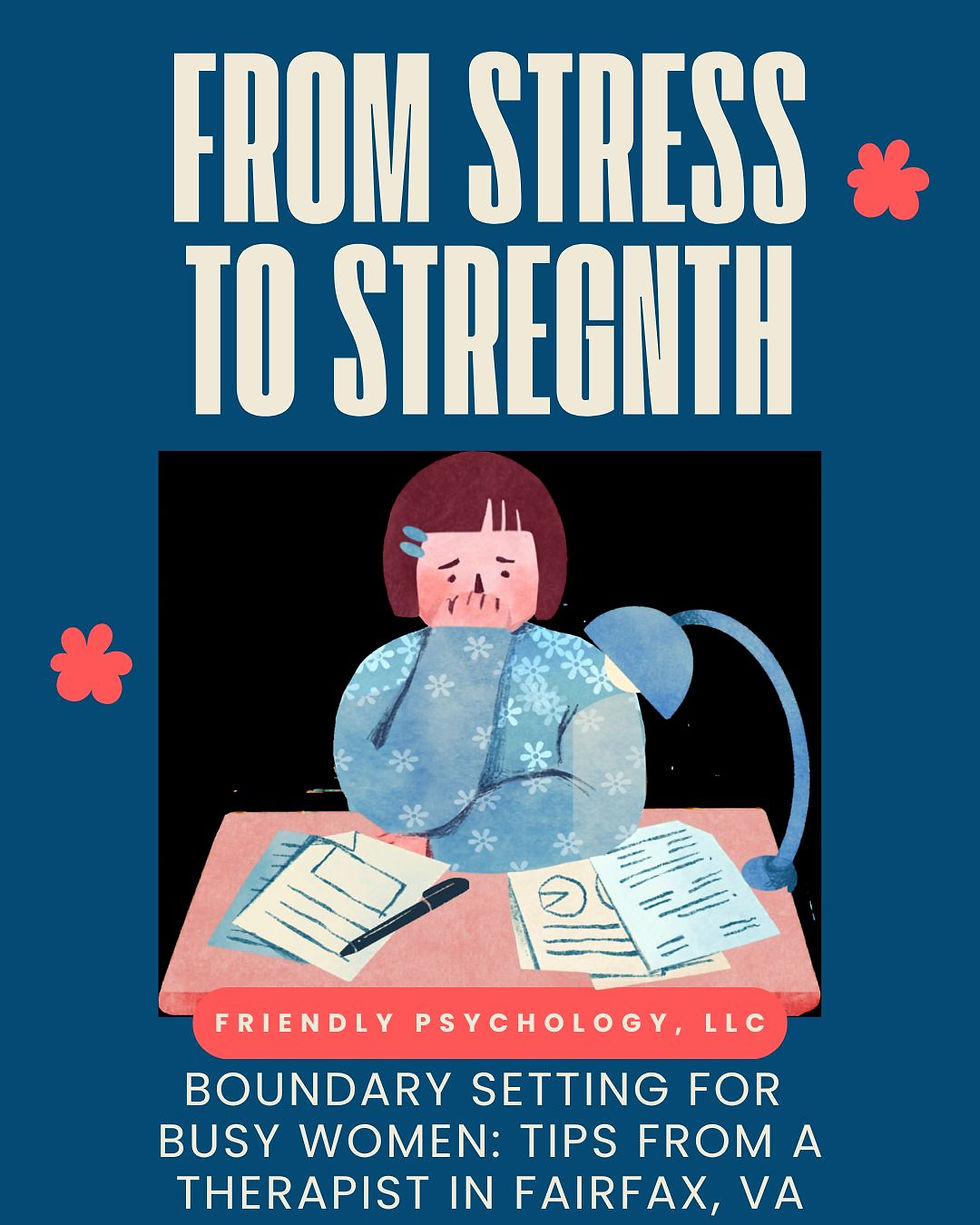
From Stress to Strength: How a Therapist in Fairfax, VA Helps Women Prioritize Their Needs Without Guilt
- rfriendly
- Jun 15
- 5 min read
Last week, a client told me that she “couldn’t” set a boundary with her partner because it would upset him and he would pout. Now, grown-ass people’s tendencies to throw tantrums when they don’t get their way aside (!!), this brought up a really important conversation with this client about what is and what is not her responsibility in relationships.

What is her responsibility?
Communicating her needs clearly and kindly.
What is not?
The other person’s emotional reactions or behavioral choices following her reasonable expression of a need.
Women are socialized to manage others’ emotions and prioritize others’ needs to such an extent that a lot of the women I work with literally don’t know what their needs are anymore. And they are exhausted.
As a therapist in Fairfax, VA, I help women turn this chronic people-pleasing and over-functioning into steady self-care and self-trust and reclaim their sense of self without the guilt. Read more in my previous post, From Stress to Strength: Transformations with a Therapist in Fairfax, VA. And read on to see how therapy can help you center yourself without drowning in guilt.
The Basics: How Therapy Begins
In your early therapy sessions, your therapist will be learning about your relationship history, the patterns and dynamics that you tend to enact, your current stressors, and the impact all of this is having on you. They will also be assessing what matters to you, so that the work you do and the goals you set can be grounded in personal values rather than your own guilt or the therapist's agenda.
A good therapist will normalize common fears about prioritizing yourself. They will help you to understand the qualities of healthy relationships, both with yourself and others, and the way that socialization and guilt can play a role in your struggles. You will then set some collaborative goals for what the work might look like and the outcomes you can expect to achieve. These goals will likely include experimenting with boundary-setting and increasing self-care and self-trust.
Practical Boundary Skills and Communication Practice
The way this work plays out in session will differ depending on the modality of therapy you choose (e.g., talk therapy, behavioral therapy, experiential therapy, relational therapy, etc. Check out my previous post, From Stress to Strength: Transformations with a Therapist in Fairfax, VA, for more information about what these different approaches to therapy can look like). However, there will likely be some commonalities around helping you to develop healthy boundary-setting skills and productive approaches to communication.
Your therapist may use time in session to help you to discern reasonable boundaries from perfectionistic demands (hint: most women who struggle with this issue have very reasonable needs, they just have difficulty believing their needs should be priorities for others). They may work with you to “rehearse” or role-play skills like saying no, making requests, and negotiating without over-explaining. They may encourage you to experiment in session with asserting your needs in the context of the therapy relationship. This can evolve over time to experimenting with real-life, gradual exposure outside of therapy. You may start with low-risk boundary-setting challenges (like being truthful with sales staff) and approach higher-stakes situations (like challenging ongoing dynamics with loved ones) as your anxiety about centering yourself begins to diminish. Finally, a good therapist will help you develop strategies for managing pushback and holding boundaries over time, since this can be the most difficult part of boundary-setting.
Remember, the people in your life who have been benefitting from your difficulty voicing your needs are not always going to take this change gracefully. That doesn’t mean it is the wrong thing to do! Ultimately, the people who value building a healthy relationship with you will come to value your self-knowledge and get used to your new ways of relating over time. And if they don’t, that’s useful information too.
Healing Underlying Patterns that Fuel Over-Giving
We can change our behavior in the moment, but in order to address the guilt that can come up when we do, effective therapy also needs to offer healing to the wounds that created these dynamics in the first place. Again, this will look different in different kinds of therapy, but the process generally includes identifying and addressing early experiences that drive caretaking and self-sacrifice, processing emotions related to these experiences, making intentional shifts in the internal rules that drive these behaviors, and strengthening self-trust.
Identifying Early Wounds:
The reason socialization is so tricky to undo is because we all learn at a young age, either directly or vicariously, what it means to break the rules. When we don’t adhere to the roles we are assigned, we risk rejection and abandonment, which are existential threats, especially to a young child. Before we can change our ways of interacting with these roles in a lasting way, we must take the step of learning about these early experiences and their impact with curiosity and compassion so that we can acknowledge how we got to where we are.
Processing Emotions:
Common emotions that come up when we do this work include grief, sadness, anger, fear, and shame. It is really important to create space for these emotions as they come up so that you can metabolize them and move through them to the peace and centeredness on the other side. As we say in the therapy world: the only way out is through!
Rewriting Internal Rules:
Socialization keeps us stuck because the rules we internalize come up unprompted, and often without our even realizing it. So, if we want to change our relationship to ourselves or our lives, we need to be intentional about changing these internal messages. For example, we may shift from, “it’s my job to make sure everyone is okay,” to “I can care for others while still honoring myself.”
Strengthening Self-Trust:
As you do the work and begin to make changes in how you relate to others and to yourself, all the parts of you, body, mind, and spirit, will begin to learn that you can be trusted to care for yourself. Gradually, you will move from being afraid of being abandoned to committing to not abandoning yourself anymore.
Choosing the Right Therapist in Fairfax, VA To Do This Important Work
This work of reconnecting to yourself and your needs is difficult, sacred work. It can be lifechanging. You need a skilled, compassionate partner in that work, and that’s where finding the right therapist for you comes into play.
Look for someone with good clinical expertise. You will want to look for a licensed mental health professional (licensed psychologist, LMFT, LPC, LICSW, etc.) who is experienced in supporting over-functioning women. If you are doing telehealth, you will want to make sure that they are licensed to practice in the state in which you are located.
Make sure the logistics work for you. Check out location, modality (in-person versus telehealth), fee structure, and scheduling.
Prioritize a good therapeutic fit. Look for someone who expresses empathy and compassion, has a collaborative and respectful style, and with whom you feel comfortable, seen, and heard. This is one of the most important things, because the research repeatedly shows that the relationship between you and the therapist is the best predictor of how effective therapy will be, so don’t settle here!
If you’ve ever felt like your life should be more than this, it can be. And you don’t have to do it alone. Working with a therapist in Fairfax, VA can help you to move from chronic self-neglect to sustainable self-trust, without guilt, through evidence-based work that is tailored to your needs.

Rachel W. Friendly, PhD — Licensed Clinical Psychologist and therapist in Fairfax, VA. I help women exhausted from prioritizing everyone else learn to set boundaries, cultivate self-compassion, and build self-trust using evidence-based, collaborative therapy. Interested in personalized support? Learn more about my services and book a consultation today.


Comments