From Stress to Strength: Boundary Setting for Busy Women (Practical Tips from a Therapist in Fairfax, VA)
- rfriendly
- 3 days ago
- 5 min read
Do you ever look around and think, “Holy shit, how did we get here?” Between work and family and home and health and ALL the tasks, when do you get to take care of yourself?
For many women, the answer is: never. We stop noticing because it’s demoralizing to pay too close attention, but it’s true. So, we keep saying yes, keep getting things done, and keep staying afloat.
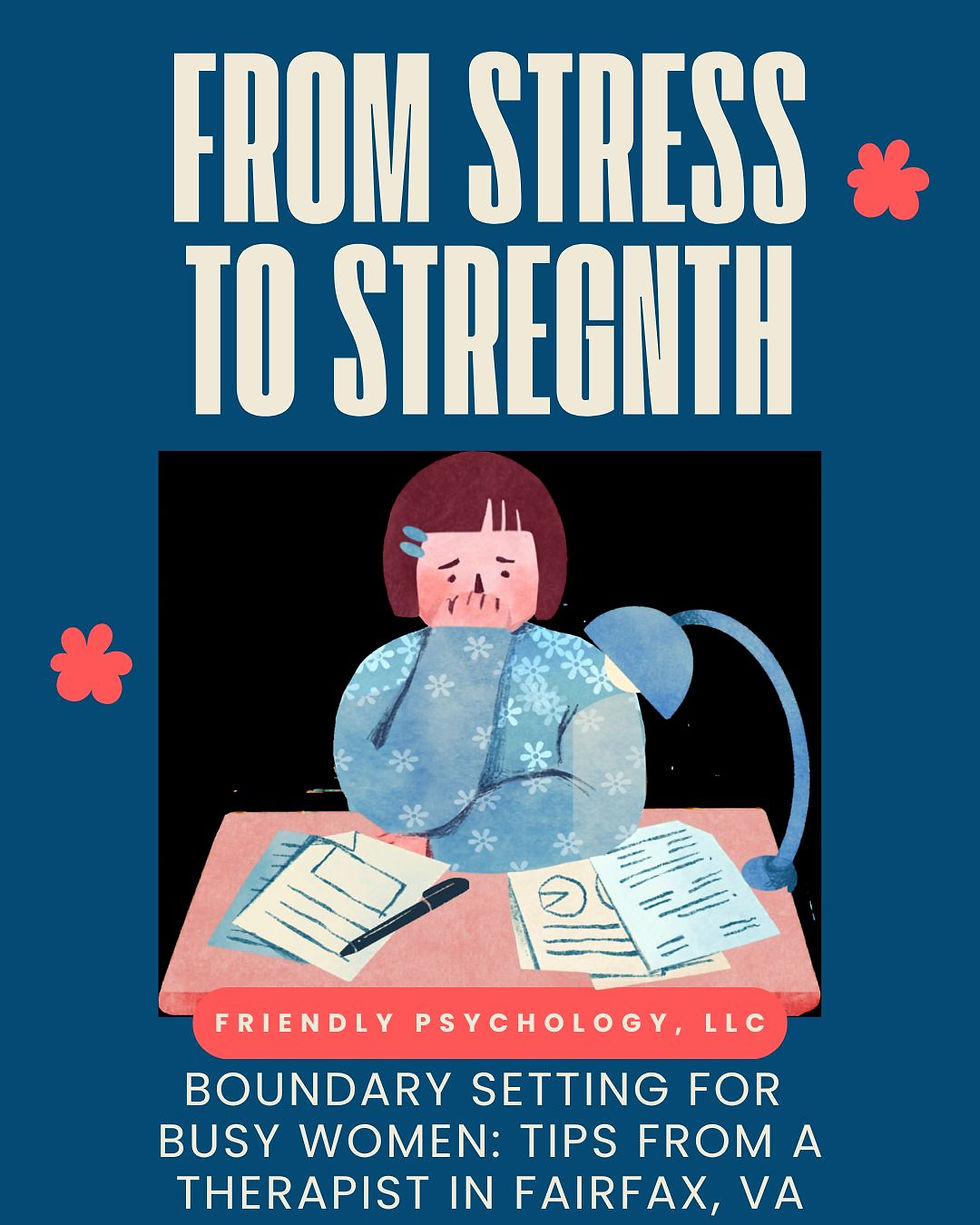
But it’s freaking EXHAUSTING.
I am here to say, you deserve to be a priority. Your needs matter. Your boundaries matter. You matter. For your own sake, not just for what you do for others.
If that feels hard to hear, therapy can help. Read my previous post, From Stress to Strength: Transformations with a Therapist in Fairfax, VA, to learn more. And read on for actionable strategies to help busy women reclaim time, energy, and self-respect amid modern overwhelm.
Start by Getting Clarity
Before you set boundaries, it helps to identify what you actually need. A useful place to begin is with your values:
What matters most to you?
Who is the woman you want to be?
Where does your life support those priorities, and where are the gaps?
Anchoring boundaries in values helps you act from intention rather than from guilt or habit.
Then, do an “energy audit.” Where are your time and energy going now? Which relationships or responsibilities energize you, and which leave you depleted? Looking at this holistically clearly highlights unsustainable patterns and shows where you might want to start experimenting.
Be Aware of What Is (and Isn’t) Yours to Carry
As you map values and energy, notice the difference between “wants” and “shoulds.” Most of us have internalized obligations that are not really ours to carry, and, upon closer reflection, many of these “obligations” turn out to be optional:
Is bedtime really your obligation every night just because your child prefers it? Might it actually be more helpful to teach your child flexibility and give yourself a break at the same time?
Do you really need the house spotless in case someone drops by? What’s the worst that could happen if it isn’t?
Must you stay quiet when your sister-in-law says something hurtful to avoid disturbing other family members’ peace? Why are others’ emotions more important than your own? (HINT: The answer is that they aren’t, we’ve just been trained to think they are, and it’s quietly killing us inside.)
Unpacking these obligations reveals patterns of belief about your role in the world. And noticing these patterns is the first step to change. After all, you can’t change what you can’t see! This process can feel hard and painful, so be patient with yourself. And consider working with a therapist in Fairfax, VA if it feels like too much to do alone.
How Do I Even Set a Boundary?
Clearly, Kindly, and Firmly
Author and podcaster Glennon Doyle says, “The most revolutionary thing a woman can do is not explain herself.” ‘No’ is a complete sentence. But women are socialized to apologize for and qualify our ‘no,’ to the extent that it actually feels rude just to be honest without over-explaining.
Practice short, direct phrases:
“I’m not available that day.”
“I can’t do that.”
“That won’t be possible.”
These are clear, kind, and firm, and they tell the other person exactly where your boundary is.
If these kinds of responses feel too brusque for relationships you are trying to preserve or deepen, you can offer acceptable alternatives (e.g., “I am not available that day, but I could do a week from Friday,” “It won’t be possible for me to drive out to see you, but if you’d like to speak over the phone next week, I would be happy to do that,” or “My body is not open for discussion, but I would love to hear about what the kids are up to these days.”). The key is avoiding waffling, over-apologizing, or being unclear.
Crucially, don’t let assumptions about someone’s reaction determine whether your needs get acknowledged.
(Read that again because it is really important! I mean it... I’ll wait.)
Two important truths:
1) You can’t predict how someone will respond if you’ve never set a boundary with them before. You are not a mind reader, I promise!
2) If they react poorly, that reaction is not your responsibility. You’ve been honest and reasonable, and that’s all you can do. This is a hard one, because many of us have been taught that if someone is upset, that means we have done something wrong. But really, you can’t be responsible for what you can’t control, and other people’s emotions are way beyond your control.
Again, your job when setting a boundary is: be clear, be kind, be firm. That’s it!
Managing Emotional Resistance and Guilt
If all of this feels impossible, that makes sense. You have been taught from childhood to prioritize the care and comfort of others above your own. So, it is totally normal to feel some anxiety and guilt when you begin to experiment with setting healthy boundaries. But I am here to tell you that it is possible to live a boundaried, self-compassionate life that is also full of loving, caring relationships with others. In fact, it is the only way. As the author and activist Prentiss Hemphill said, “Boundaries are the distance at which I can love you and me simultaneously.”
So, when the guilt shows up and the anxiety creeps in, work on your self-compassion. Remind yourself that it is not selfish to have needs, it is human. Remind yourself that you matter too. That when needs collide, someone is going to be disappointed, and that someone should not be you by default.
And then notice what happens to your energy as you begin to experience more agency in your life. And notice what happens in your relationships over time. Because chances are, the healthy ones are going to get even healthier once the other person actually knows what you need from them.
Responding to Pushback and Relational Fallout
The hardest part of boundaries work isn't usually setting the boundary. It is holding the boundary in the face of pushback or emotional punishment. It’s important to remember that the people in your life who benefited from your lack of boundaries may not be thrilled about your newfound empowerment. They may be surprised, disappointed, or even angry, and they may test your limits, throw tantrums, pout, or lash out in all sorts of ways.
NOTE: This does not mean you are wrong!
You can have empathy for someone’s reaction and validate their emotions while still maintaining your boundary. When needed, you can even explain the purpose of the boundary and reaffirm how much you care about the relationship while still maintaining the boundary.
Most people who care about you will adapt, even if it takes time. Some won’t be able to accept the change, and that’s important information too. It may mean having a heart-to-heart, seeking counseling together, creating emotional or physical distance, or even letting the relationship go. Allow yourself to grieve losses that come with necessary change. Remember, you are doing what’s healthy for you and you deserve people who truly value you.
Boundary-Setting Is a Skill You Can Learn
Boundary-setting isn’t an innate trait reserved for a few “empowered” women, it’s a skill you can develop. Empowerment, self-compassion, and self-trust are all within reach.
If this all feels overwhelming, therapy can help you challenge old programming, experiment with new behaviors, and practice bringing those changes into your life. You don’t have to do this alone! Reach out to a therapist in Fairfax, VA today to begin your transformation.

Rachel W. Friendly, PhD — Licensed Clinical Psychologist and therapist in Fairfax, VA. I help women exhausted from prioritizing everyone else learn evidence-based boundary skills, develop self-compassion, and build self-trust. I offer collaborative, practical therapy in-person and via telehealth. Interested in personalized support? Learn more about my services and schedule a consultation today.


Comments